

How to Find Joint Venture Partners for Real Estate Projects in Arizona
If you’ve been looking at real estate deals in Arizona but feel like you’re missing a piece, whether that’s capital, experience, or just the right connection, you’re not alone. A lot of investors hit that wall. So, How to Find Joint Venture Partners for Real Estate Projects in Arizona?
The good news? You don’t have to have everything figured out on your own. That’s exactly what a joint venture (JV) is for.
Real estate joint ventures are becoming increasingly common in Arizona fix-and-flip, rental, and value-add investment strategies.
In this article, we’ll break down what a real estate joint venture actually looks like, how to find the right partners in Arizona, and what makes a JV deal work, so you can start doing more deals, faster.
Table of Contents
- What Is a Real Estate Joint Venture?
- Why Arizona Is a Strong Market for JV Deals
- Who Do You Need in a JV Partnership?
- Where to Find Joint Venture Partners in Arizona
- How to Structure a Real Estate Joint Venture
- Common Mistakes to Avoid
- FAQ: Joint Ventures in Arizona Real Estate
1. What Is a Real Estate Joint Venture?

A joint venture in real estate is simply a deal where two or more people or companies come together to work on a project, and split the results.
One person might bring the capital. Another brings the deal-finding skills, the construction knowledge, or the time to manage the project. Together, they can do something neither could pull off alone.
JVs are common in fix and flip projects, buy-and-hold investments, and new construction deals. They’re not a shortcut, they’re a strategy. And when structured correctly, they protect everyone involved.
A joint venture isn’t just about money. It’s about combining what you have with what someone else has, and creating something bigger together.
2. Why Arizona Is a Strong Market for JV Deals
Arizona, especially the Phoenix metro area, has been one of the most active real estate markets in the country over the past several years. Population growth, a strong job market, and relatively affordable entry points (compared to California or New York) make it attractive for investors at every level.
That creates real opportunity for joint ventures:
- There are more deals available, especially in fix and flip and value-add properties.
- Private capital is active in the market, with hard money lenders and individual investors looking for solid deals.
- The market moves fast, so having a reliable partner with capital or connections helps you act quickly.
- There’s a growing community of local investors actively looking to collaborate.

Whether you’re based in Phoenix, Scottsdale, Tempe, Mesa, or anywhere across the Valley, the infrastructure for JV deals is here.
Arizona’s Growth Is Creating Opportunity. But Also Bigger Barriers
Over the past several years, Arizona has attracted investors, businesses, and new residents from higher-cost states like California and Washington. That growth has created strong demand across many parts of the market, especially in Phoenix and the surrounding metro areas.
But growth also creates pressure.
Higher acquisition costs, more competition for distressed properties, rising construction costs, and tighter margins have made it harder for newer investors to compete alone.
That’s one reason JV partnerships are becoming more common across Arizona.
Experienced operators are looking for reliable capital. Capital partners are looking for trustworthy deal-finders. And newer investors are realizing they can enter the market faster by partnering with people who already understand local neighborhoods, contractors, timelines, and deal structures.
In markets like Mesa, Glendale, Tempe, and Tucson, local knowledge can dramatically affect the outcome of a project, which makes the right partnership even more valuable.
3. Who Do You Need in a JV Partnership?
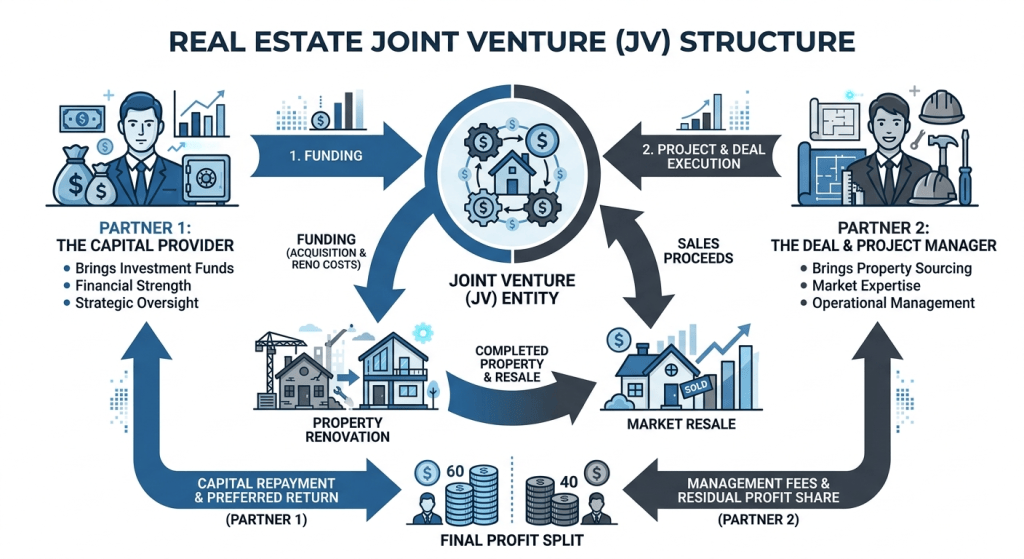
Every successful joint venture comes down to one simple idea: each partner brings something the other doesn’t have. Here are the most common partnership types:
The Deal Finder
This person has the time, hustle, and market knowledge to find undervalued properties. They may not have the cash to close, but they know how to identify opportunity.
The Capital Partner
This is someone, often a private investor or a lending group, who provides the funding to make the deal happen. They want a return on their money without having to manage the day-to-day.
The Operator
Some JVs involve a third role: someone who manages the project. This could mean overseeing contractors, handling timelines, or managing a rental property after acquisition.
In many Arizona fix and flip deals, two people share these roles, one bringing money, one bringing sweat equity. But understanding which role you’re playing (and what your partner needs) is key before you ever sign anything.
What a Real JV Deal Can Look Like in Arizona
Imagine an investor finds a distressed property in Mesa listed at $285,000. After walking the property and running the numbers, they estimate the renovation will cost another $60,000.
The problem? They don’t have enough liquidity to comfortably fund both the purchase and the rehab while still protecting their reserves.
Instead of walking away from the opportunity, they partner with a capital investor.
In this scenario:
- The operator finds the deal, manages the contractors, and oversees the renovation.
- The capital partner helps fund the acquisition and rehab costs.
- Both parties agree upfront on timelines, responsibilities, and how profits will be distributed after the property sells.
Neither partner could have executed the deal as efficiently alone, but together, the project becomes realistic, scalable, and profitable.
That’s the real advantage of a well-structured joint venture: it allows investors to combine strengths instead of being limited by individual weaknesses.
4. Where to Find Joint Venture Partners in Arizona

This is the question most investors ask first, and the answer is simpler than you’d think. Partners are everywhere. The trick is being in the right rooms.
Real Estate Investment Groups
Local REIA (Real Estate Investors Association) meetups and investment clubs are one of the most consistent ways to find partners. These events attract people at every stage, from first-timers to experienced operators looking for their next deal.
Hard Money Lenders and Private Lenders
Lending groups that work with real estate investors often know the market better than anyone. Some of them, like Metro Private Lending, have built communities specifically designed to connect deal-finders with capital partners. That kind of network can accelerate your timeline significantly.
Online Communities
Facebook groups, BiggerPockets forums, and LinkedIn are all active places where Arizona investors connect. Look for groups specific to Phoenix real estate, Arizona fix and flip, or local landlord communities.
Title Companies and Real Estate Attorneys
Professionals who handle closings on investment deals meet investors constantly. A good title rep or real estate attorney can often make an introduction that turns into a partnership.
Your Existing Network
Don’t underestimate the people you already know. A lot of joint ventures start with someone saying, “I found a deal, but I need help.” Share what you’re doing, you’d be surprised who’s interested.
5. How to Structure a Real Estate Joint Venture
Once you’ve found a potential partner, the structure of your JV is what makes or breaks the deal. Here are the basics:
Define Each Partner’s Role Clearly
Put in writing who is responsible for what: finding the deal, funding it, managing construction, handling the sale. Vague agreements lead to conflicts.
Agree on the Split Before You Start
Profit splits in JV deals vary widely, 50/50, 60/40, 70/30, depending on what each party contributes. There’s no universal formula. What matters is that both sides feel the arrangement is fair.
Use a Written Agreement
Even if you’re working with someone you trust, get it in writing. A simple JV agreement should cover: contributions from each party, decision-making authority, profit distribution, exit strategy, and what happens if things go sideways.
Consider Your Financing Structure
Some JV deals are funded entirely with private capital. Others combine a hard money loan for the purchase with a capital partner covering the rehab costs. Knowing your financing structure upfront helps you approach the right partners.
The best JV agreements are ones where both people walk away feeling like they got a fair deal, not just the first one, but every deal after.
6. Common Mistakes to Avoid
A lot of JV partnerships don’t fail because the market changes. They fail because problems were ignored early.
The investors who consistently succeed with joint ventures aren’t the ones who never encounter issues, they’re the ones who know how to identify bad partnerships before the deal ever closes.
Here are some of the biggest warning signs to watch for:
Vague or Verbal-Only Agreements
“Let’s figure it out later” is one of the most dangerous phrases in real estate investing.
If a partner avoids putting terms in writing, hesitates to define responsibilities clearly, or relies entirely on verbal promises, that’s a major red flag. Every JV deal should have a written agreement that outlines contributions, responsibilities, timelines, profit splits, and exit strategies.
Handshake deals work, until something goes wrong.
Unrealistic Deal Projections
If the numbers feel too optimistic, they probably are.
Be cautious of:
- rehab budgets that seem unusually low,
- timelines that ignore permitting or contractor delays,
- or projected profits that don’t match current market conditions.
Strong JV partnerships are built on realistic expectations, not inflated spreadsheets designed to make a deal look exciting.
Partnering Based on Trust Alone
Trust matters. But trust without due diligence creates expensive mistakes.
Before entering a joint venture, verify:
- past projects,
- contractor relationships,
- financial capacity,
- and overall experience.
A good partner should be comfortable answering direct questions about their track record and process.
No Clear Exit Strategy
One of the fastest ways for a JV deal to become stressful is when partners never fully discussed how the project ends.
Is the property being flipped quickly? Held as a rental? Refinanced after stabilization?
And what happens if:
- one partner wants out early,
- the market shifts,
- or the project takes longer than expected?
The best time to define the exit strategy is before the project begins — not during a disagreement halfway through the deal.
No Skin in the Game
Healthy partnerships require aligned incentives.
If one partner takes on all the risk while the other is fully protected regardless of outcome, the structure is usually flawed. Whether someone contributes capital, time, expertise, or operational oversight, every serious partner should have meaningful responsibility tied to the success of the project.
The strongest JV deals happen when both sides are equally committed to making the investment work.
Not Working With Professionals
Even experienced investors use professionals to protect themselves.
A real estate attorney can help structure the agreement properly. A CPA can help avoid tax mistakes. Title companies help uncover liens and ownership issues before closing.
Trying to shortcut professional guidance to “save money” often becomes far more expensive later.
A strong joint venture isn’t just built on opportunity, it’s built on clarity, structure, and aligned expectations from the beginning.
FAQ: How to Find Joint Venture Partners for Real Estate Projects in Arizona
Can I do a joint venture if I have no money?
Yes, if you bring something else to the table. Many JV deals are structured so that one partner provides the capital and the other provides the deal, the work, or the expertise. No-money-down investing through JVs is a real strategy, but you need to bring genuine value to your partner.
Do I need a license to do a joint venture in Arizona?
Generally, no license is required to enter into a JV agreement as an investor. However, if you’re acting in a capacity that requires a real estate license (like representing buyers or sellers), different rules apply. Always consult a licensed professional for your specific situation.
What’s the difference between a JV and a hard money loan?
A hard money loan is a debt, you borrow money and pay it back with interest, regardless of whether the deal succeeds or fails. A joint venture is a partnership, both parties share in the risk and the reward. Some investors use both: a hard money loan to purchase the property and a JV partner to fund the rehab.
How do I find serious investors in Arizona vs. people who are just talking?
Look for people with a track record. Ask about past deals. Attend real estate events where active investors gather, not just online forums. And connect with communities built specifically around deal-making, not just conversation.
How long does it take to close a JV deal in Arizona?
It depends on the deal and the financing. With private capital already in place, some JV deals close in as little as 7–14 days. The more prepared both partners are upfront, the faster things move.
Ready to Explore a JV Opportunity in Arizona?
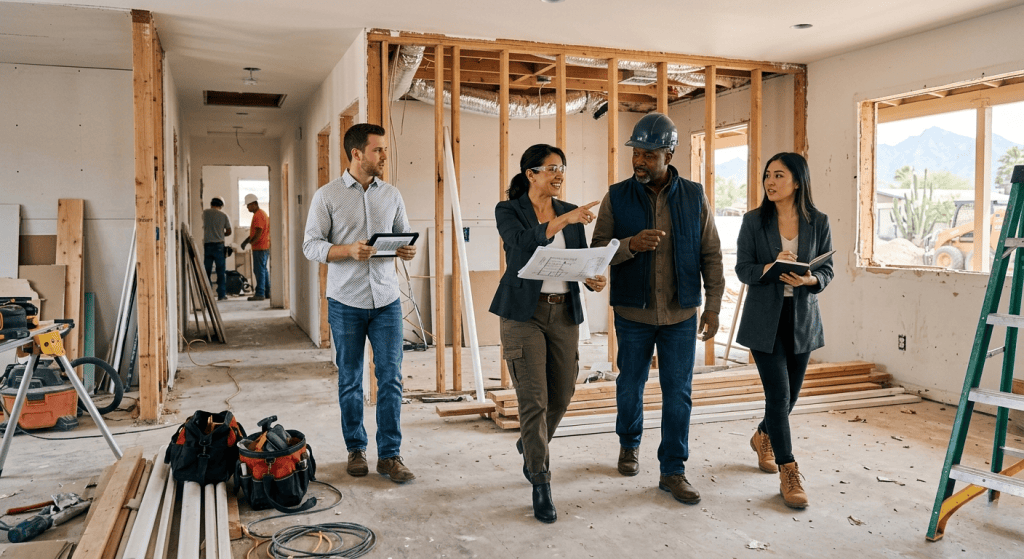
If you’re an active investor, or someone who’s ready to start, having the right community around you makes all the difference. Metro Private Lending has built exactly that: a network of deal-finders, capital partners, and experienced operators who work together on real deals across the Arizona market.
Whether you’re:
- looking for capital for your next deal,
- searching for experienced operators,
- or trying to break into real estate investing through partnerships,
having the right network matters.
Metro Private Lending and the Metro Flip Club Capital Partnership program were built to help Arizona investors connect with people who are actively looking to do real deals, not just talk about them online.
If you want to explore partnership opportunities, submit a potential deal, or learn how our JV structure works:
👉 Learn More About the Metro Flip Club Capital Partnership Program
About Metro Private Lending
Metro Private Lending is an Arizona-based private lender and investment community focused on real estate. We offer hard money loans and joint venture partnerships to investors across the Phoenix metro area. Our Metro Flip Club connects experienced capital partners with active deal-finders to make more projects happen, faster.
This article is for educational purposes only and does not constitute legal, financial, or investment advice. Always consult a qualified professional before entering into any investment agreement.