

The Strategic Investor’s Playbook: Mastering Real Estate Investment Training in 2026 (With a Deep Dive into Arizona’s Booming Markets)

If you’re reading this, you’re probably trying to figure out how to get started in real estate investing, not just watch videos about it. And that’s where most people get stuck.
There’s no shortage of content. You can spend months on YouTube, podcasts, and social media and still not feel confident enough to analyze a deal, talk to a lender, or move forward on a property.
This guide is designed to give you structure. This is not a blog post. This is a working playbook.
If you follow it properly, you should be able to go from “I’m interested in real estate” to understanding how deals work, how markets behave, and what your first steps should look like in today’s 2026 market.
No hype. No shortcuts. Just the fundamentals that hold up when real money is on the line.
If you only take one thing from this entire guide, let it be this:
Real estate investing rewards execution, not information.
The following roadmap is designed to remove the guesswork and give you a clear path forward.
Section 1: Why Real Estate Investment Training Matters More Than Ever in 2026
Real estate has built more generational wealth than any other asset class in American history. It has also wiped out investors who went in underprepared. The difference between the two outcomes is rarely luck; it’s education.
In 2026, the landscape has shifted considerably. Mortgage rates have stabilized above 6%, with the NAR’s chief economist projecting rates around 6.4% through the back half of the year and dipping toward 6.1% into 2026. The easy-money era of the early 2020s, when appreciation practically did the work for investors, is over. What has replaced it is a market that rewards those who understand cash flow, financing mechanics, and local market dynamics.
That’s precisely why real estate investment training has never been more valuable.
But here’s where most new investors go wrong.

The YouTube Trap vs. Structured Training
There is no shortage of free content online. You can watch hundreds of hours of real estate videos without spending a dime. But information and education are not the same thing.
Free content gives you fragments. Structured training gives you a system, a repeatable framework for analyzing deals, building teams, managing risk, and scaling intelligently. The difference shows up when things go wrong: a contractor disappears mid-rehab, a tenant stops paying, a deal falls apart at closing. Investors who were trained for those moments navigate them. Those who learned from YouTube often don’t.
The most expensive real estate education is the kind you pay for in failed deals rather than in tuition.
The Market Rewards the Prepared
Secondary markets, mid-sized cities outside the major metros, are where many of the strongest 2026 opportunities live. These markets are less picked-over, offer better entry prices, and tend to deliver more reliable cash flow. But identifying them, underwriting them correctly, and operating in them requires knowledge that goes well beyond surface-level market “hot takes.”
Before we go deeper, you need a simple way to think about real estate investing.
Every successful investor, whether they realize it or not, operates across three core pillars:
- Market — Where you invest and why demand exists there
- Deal — The numbers, structure, and risk of the specific property
- Execution — Your team, financing, and ability to operate the asset
Most beginners fail because they focus on one and ignore the others.
This playbook is structured to help you understand and connect all three, because that’s where real results come from.
Section 2: The 10 Costliest Mistakes New Investors Make (And How Training Prevents Them)
Every new investor makes mistakes. Trained investors make smaller ones. Here are the ten mistakes that consistently cost beginners the most, and what a solid educational foundation does to prevent each one.
These aren’t theoretical mistakes.
These are patterns that consistently show up in real deals, the kind that cost beginners time, money, and sometimes their entire entry into real estate.

- No Strong Team Trying to DIY contractor relationships is one of the fastest ways to blow a budget and a timeline. Experienced investors build a vetted bench before they close a deal.
- Biting Off Too Much Too Soon. New investors who jump straight to multi-lot subdivisions or large multifamily portfolios almost always hit problems that would have been manageable on a single-family or small duplex. Start where you can learn without a catastrophic downside.
- Misunderstanding Construction Draws: Private and hard money lenders release funds in draws tied to completed work, not upfront. Expecting a lump sum at closing is a rookie mistake that leads to cash-flow crises mid-project. In simple terms, lenders don’t give you all the renovation money up front. They release funds in stages as work gets completed, which means you need enough cash flow to start and sustain the project.
- Timeline Fantasy Closings do not happen in 24 hours. Rehab does not take two weeks. Investors who plan for best-case scenarios on timelines consistently blow their budgets on holding costs.
- Overestimating After-Repair Value (ARV). The most common valuation error: pulling comps from a better neighborhood or newer construction to justify a higher ARV. Your property’s ARV is determined by comparable properties, not aspirational ones.
- Underestimating Capital Needs: Purchase price is just the beginning. Holding costs, insurance, loan fees, property taxes, utilities, and unexpected repairs are all real expenses that eat into returns. Undercapitalized investors. This is where many first-time investors get forced into bad decisions. Selling early. Taking on expensive debt. Walking away from deals that could have worked with proper planning.
- Ignoring the Numbers Falling in love with a property’s aesthetics or potential rather than running honest spreadsheets is the single most common cause of bad deals. The numbers don’t lie. Personal attachment does.
- No Exit Strategy: Short-term bridge loans and hard money have maturity dates. Investors who take on short-term financing without a clear exit, refinance, sell, or pay off, face costly extensions, forced sales, or default. Every deal should have at least two exit strategies before you close.
- Chasing Hot Markets: Buying at peak pricing in a market everyone is talking about is how investors overpay. By the time a market is “hot” in the mainstream, the best entry points have passed.
- Poor communication, ghosting lenders, partners, or service providers kills deals and reputations. Real estate is a relationship business. Your communication habits are your brand.
Section 3: Where Smart Money Is Moving — The US Market Landscape in 2026
Before you look at any deal, you need to understand the environment you’re operating in.
Because strategy without context is how investors lose money.
The Macro Shift Investors Need to Understand
The investor share of home purchases has normalized significantly since the pandemic frenzy. Where institutional and individual investors once accounted for roughly 31% of transactions in major metros in 2021, that share has dropped back toward 20%. That is not a sign of a dying opportunity; it is a sign of a more rational market with real entry points.
The sweet spot in terms of price point remains the $300,000–$699,000 range, which accounts for more than two-thirds of investor-relevant sales nationally. This is where the deepest inventory lives, where financing is most accessible, and where the pool of potential buyers and renters is largest.
What this means in practice:
You can no longer rely on appreciation to fix a bad deal.
A good market won’t save a bad deal. But a good deal can survive a changing market.

From Appreciation Plays to Cash Flow Markets
The most important strategic shift of 2026 is the move from “appreciation plays”, buying in high-growth markets and riding price increases, to “cash flow markets,” where the income the property generates justifies the purchase independently of future appreciation.
This shift matters because:
- Appreciation is speculative
- Cash flow is operational
- Higher rates make negative cash flow harder to sustain.
If you’re new, this is the simplest way to think about it:
Buy for income first. Let appreciation be a bonus, not the strategy.
The Retail Real Estate Opportunity
One underreported opportunity in 2026 is second-generation retail, existing retail spaces available at below-replacement cost. These properties, particularly in Sun Belt markets, are generating IRR (internal rate of return) potential in the 12–18% range as retail demand normalizes and supply remains constrained. This is not a beginner play, but it is one worth understanding as you advance.
IRR (internal rate of return) measures the overall profitability of an investment over time, factoring in both income and appreciation.
Section 4: Arizona Deep Dive — The Southwest’s Investment Powerhouse
Why Arizona? The Macro Case
Arizona is not just a hot market. It is a structurally sound investment environment, and the data backs it up across multiple dimensions.
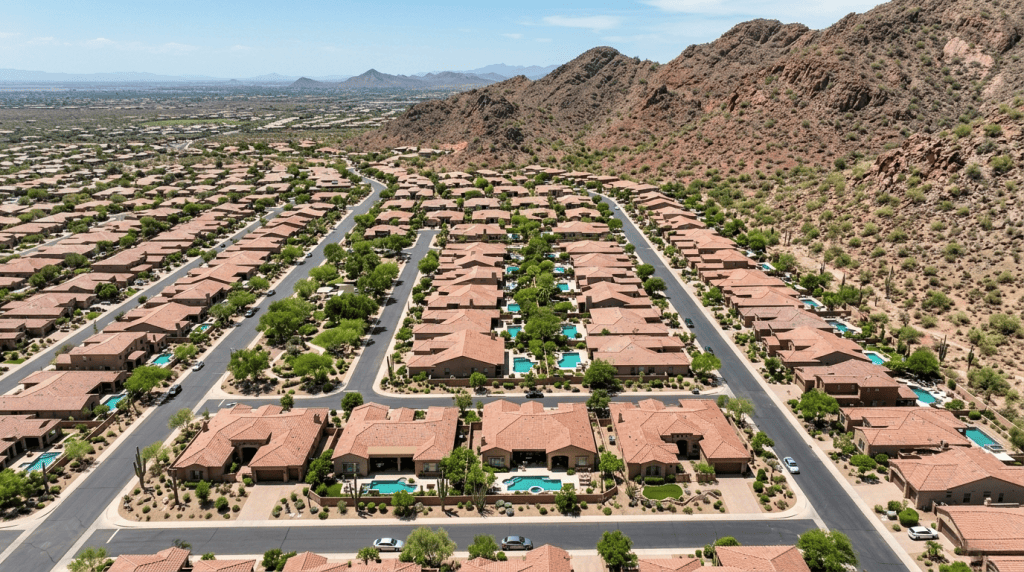
Population Growth: Arizona ranks in the top five nationally for net migration. People are moving here from California, Illinois, and the Pacific Northwest in significant numbers, driven by the lower cost of living, warm climate, and expanding job markets. That sustained in-migration creates durable, long-term rental demand.
Landlord-Friendly Laws: Arizona has no statewide rent control, efficient eviction processes, and a legal environment that respects property owner rights. For investors managing rental portfolios, this is not a small detail; it is a fundamental determinant of operating risk.
Low Property Taxes: At approximately 0.56% of assessed value, Arizona’s effective property tax rate is among the lowest in the United States. On a $400,000 property, that translates to roughly $2,240 per year, a meaningful advantage when calculating net operating income.
Economic Diversity: The Arizona economy has diversified well beyond its historical reliance on construction and tourism. Today’s major employment sectors include technology (Intel, TSMC, and a growing semiconductor corridor), healthcare, logistics and supply chain, education, and financial services. That diversity provides recession resilience.
Market-by-Market Breakdown
🏜️ Phoenix — The Urban Powerhouse

Phoenix is the anchor market of the Arizona investment landscape. The metro added nearly 50,000 new residents in a recent single-year period, reflecting consistent, structural demand. The median home price in Phoenix sits in the $450,000–$575,000 range, depending on submarket and data source.
Current market conditions in 2026 show a buyer’s market dynamic emerging, with inventory up significantly year-over-year and homes spending more days on the market. This is genuinely good news for investors: negotiating power is back. Sellers are accepting the below-list offers and offering concessions at rates not seen since before the pandemic.
The 7.5% vacancy rate driven by new construction creates selectivity pressure; well-located properties in established neighborhoods with good school ratings lease quickly; poorly positioned properties sit. This is exactly the kind of environment where trained investors with sharp underwriting skills outperform.
Key Phoenix investment metrics:
- Median sale price: ~$444,500 statewide (2025 data)
- Market condition: Buyer’s market (inventory up 24.7% year-over-year)
- Rental yield: approximately 4.58% median
- Best strategies: Buy-and-hold single-family, small multifamily, value-add acquisitions in established neighborhoods.
🌵 Tucson — The Affordable Gem
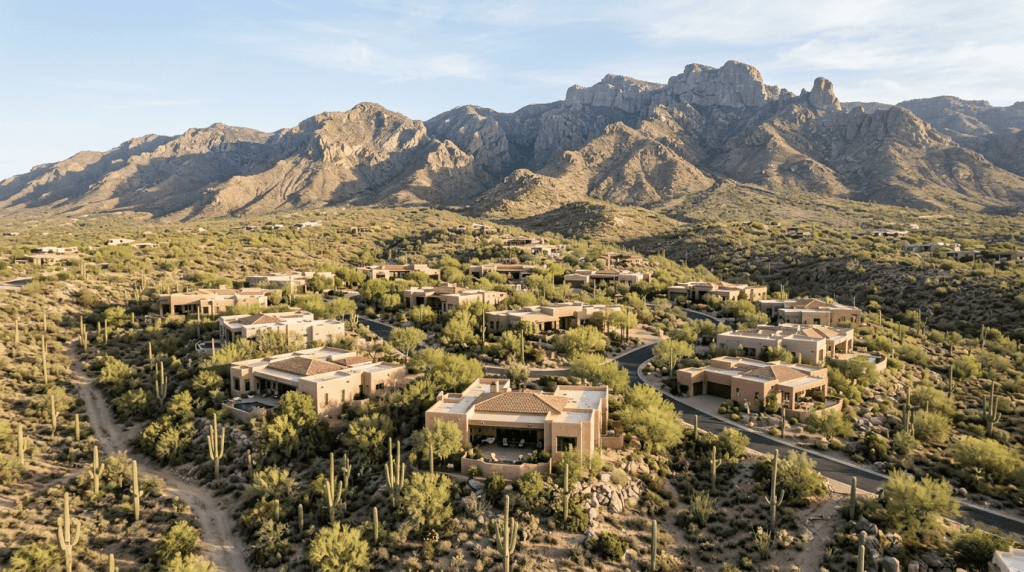
Tucson may be the most underrated investment market in the entire Southwest. While Phoenix gets the headlines, Tucson offers entry prices significantly lower ($225,000–$350,000 range), competitive cap rates of 5–6.5% on multifamily, and a diversified demand base that most markets can’t replicate.
The University of Arizona anchors a student population of over 64,000, a reliable, recurring demand driver for rental housing near campus. Add a growing healthcare sector anchored by Banner Health and the University of Arizona Medical Center, a military presence at Davis-Monthan Air Force Base, and an active short-term rental market tied to the region’s tourism and natural attractions, and you have demand diversification that most single-market investors dream about.
Properties here are moving at an average of 13 days on market with multiple competing inquiries, which suggests that well-priced, well-maintained products are still sought after despite broader market softening.
Key Tucson investment metrics:
- Median sale price: ~$225,000–$350,000
- Cap rates: 5–6.5% multifamily, 4.8%+ short-term rentals
- Average leads per rental listing: 28
- Days on market: approximately 13
- Best strategies: Student housing near UA, short-term rentals, affordable buy-and-hold
🏔️ Scottsdale — The Luxury Play

Scottsdale operates in its own tier. Home to some of the most sought-after short-term rental inventory in the country, particularly tied to spring training, golf tourism, and corporate event demand, Scottsdale offers unique upside for investors who understand the luxury and experience economy.
High-end multifamily and premium short-term rentals perform well here, with strong appreciation trends and affluent demographics supporting premium pricing. Entry costs are higher, returns require more sophisticated underwriting, and short-term rental regulations are more stringent than in other Arizona cities, but for the right investor with the right capital base, Scottsdale is in a category of its own.
Key consideration: Always verify current STR ordinances before acquiring a short-term rental property in any Arizona city. Scottsdale and Phoenix have different regulatory frameworks, and these rules evolve.
🏘️ Mesa & Chandler — The Growth Corridors

Mesa is the fastest-growing city in Arizona’s East Valley and offers one of the most accessible entry points in the Phoenix metro. Family-friendly neighborhoods, solid school districts, and ongoing commercial development are driving both residential demand and long-term appreciation potential.
Chandler is the tech corridor play. With major employers including Intel and PayPal, and a growing cluster of semiconductor and fintech companies, Chandler offers higher-income renter demographics, strong occupancy rates, and steady, predictable rental growth. Median home prices are projected to approach $800,000 in certain segments, though entry-level investment properties remain available well below that threshold.
What Makes Arizona Uniquely Challenging (Know Before You Buy)
No honest market analysis ignores the risks. Arizona has three specific considerations that every investor must account for:
Water Rights and Scarcity: Arizona sits in an arid climate with legitimate long-term water supply concerns, particularly in outer suburban areas. Properties in municipalities with established water infrastructure (Phoenix, Tucson, Scottsdale) carry less risk than those in exurban areas dependent on groundwater. Always research the water source and long-term supply outlook for any acquisition.
Cooling Costs: HVAC systems are not optional in the desert; they are critical infrastructure. Budget for higher utility costs in your cash flow analysis, factor in HVAC replacement in your capital reserves, and ensure any property you acquire has a well-maintained, modern system.
Monsoon Season: Arizona’s summer monsoon season (June through September) brings heavy rain, dust storms, and wind that can cause real property damage. Insurance coverage and maintenance reserves need to reflect this.
Section 5: Building Your Arizona Investment Strategy — From Training to Execution
At this point, the question becomes simple:
How do you go from learning to doing?
This is where most people stall. Not because they lack information, but because they lack structure.
So instead of leaving this theoretical, here’s how this looks in practice.

Phase 1: Education and Market Selection
Before spending a dollar on a property, spend real time on market education. This means:
- Running your own virtual market analysis using tools like Zillow, Redfin, Rentometer, and CoStar (for commercial)
- Conducting at least one boots-on-ground research trip before your first acquisition.
- Understanding Arizona-specific factors: city-by-city STR regulations, water utility infrastructure, seasonal rental demand cycles (snowbird patterns in Phoenix, student cycles in Tucson)
- Connecting with local real estate investors associations like AZREIA (Arizona Real Estate Investors Association), which offers subgroup meetings for new investors, deal reviews, and mentorship access.
Phase 2: Team Assembly
The Arizona market advantage is real only if you build the right local team. You need:
- Property managers who understand the specific demand drivers of your target market (student turnover cycles near UA vs. snowbird seasonality in Phoenix’s winter rental market are very different operational realities)
- Contractors familiar with desert construction, adobe, stucco, tile roofing, and the specific maintenance challenges of extreme heat
- Title companies experienced with investor-volume closings and that can execute efficiently on back-to-back or simultaneous closings.
- A lender who understands investment property financing in Arizona’s current rate environment
Phase 3: Deal Analysis, Arizona-Style
Your standard cash flow analysis needs Arizona-specific adjustments:
- Lower property taxes (0.56% effective rate) improve your NOI relative to most other markets. Make sure you’re capturing this correctly in your model, not using national averages.
- Higher cooling costs — utility expenses in Phoenix and Tucson during summer months are materially higher than national norms; use actual utility history, not estimates.
- STR regulatory verification — before underwriting a short-term rental strategy, confirm the specific city’s current ordinance. This is non-negotiable and must be done on every acquisition.
Phase 4: Scaling Within Arizona
Once you have operational cash flow on your first one or two properties, Arizona offers excellent internal scaling options:
- 1031 exchanges within Arizona — moving equity from an appreciated asset into a higher-value property without triggering capital gains taxes, potentially across different city markets.
- Market diversification — combining a Phoenix buy-and-hold with a Tucson university-adjacent property and a Scottsdale short-term rental creates a genuinely diversified Arizona portfolio across price points, demand drivers, and strategies.
- Syndication entry points — Arizona’s active investor community offers opportunities to participate in or organize small syndications for multifamily deals that would be out of reach individually.
If you’re serious about moving from theory to execution, being in the right environment matters.
Learning on your own is one thing. Seeing how deals actually come together, and connecting with people who are actively investing, is what accelerates real progress.
That’s exactly the idea behind Metro Flip Club Capitol: a space where investors bring deals, collaborate, and turn opportunities into actual projects.
If you want to see how this works in practice, you can learn more here.
Section 6: Advanced Training Topics — Beyond the Basics
Once you have your foundational training and your first deals operating, these advanced topics will determine how far and how fast you scale.

Commercial vs. Residential: When to Pivot
Multifamily properties of five or more units are classified as commercial real estate and underwritten differently, based on income rather than comps. This opens access to different financing products, different value-add strategies, and fundamentally different returns. The question of when to pivot from residential to commercial is one every serious investor eventually faces. The answer depends on your capital base, your operational bandwidth, and your market, but it’s a question you should be asking by deal number three or four.
Syndication and Partnerships
Pooling capital with partners allows individual investors to access larger deals, 20-unit apartment complexes, retail strip centers, and commercial mixed-use buildings that generate returns impossible to achieve at a smaller scale. Learning how syndications are structured legally, how waterfall distributions work, and how to evaluate a deal as either an operator or a passive investor is advanced curriculum that pays off significantly.
Tax Strategy: Cost Segregation
Arizona’s new construction boom creates an unusual opportunity for cost segregation, an IRS-approved strategy that accelerates depreciation on commercial and investment properties by reclassifying components (flooring, fixtures, landscaping, parking lots) as shorter-life assets. This can front-load depreciation deductions substantially, particularly valuable in high-income years. Work with a CPA who specializes in real estate investment tax strategy, not a generalist. In simple terms, it allows you to accelerate tax deductions earlier in the life of the property instead of spreading them out over decades.
Economic Resilience Planning
Arizona’s diversified economy provides meaningful recession resilience relative to single-industry markets. Technology, healthcare, military, education, and logistics employment bases do not all contract simultaneously. Understanding which demand segments are most cyclical, luxury STR, retail-adjacent residential, versus most stable, workforce housing near healthcare and military employers, shapes how you build a portfolio that performs through economic cycles, not just during boom periods.
Section 7: Your 30-to-90-Day Training Roadmap — From Novice to Portfolio Owner

Training without a timeline is theory. Here is a practical framework for turning education into action.
Days 1–30: Foundation and Market Selection
The goal of your first 30 days is not to buy a property. It is to build the analytical and network foundation that makes your first acquisition intelligent.
- Complete your market selection: Run a Phoenix vs. Tucson decision matrix based on your capital, risk tolerance, and investment goals. Document your reasoning.
- Analyze 10 deals without buying any. Use actual MLS listings and run full underwriting on each one. Build your spreadsheet muscle before you spend real money.
- Start team building: Connect with at least three local Arizona real estate agents who specialize in investor transactions, two lenders who work with investment properties, and one property manager in your target market.
- Legal foundation: Set up an Arizona LLC if you don’t already have one. Review landlord insurance requirements. Understand Arizona’s landlord-tenant law basics.
- Join AZREIA or a local investor group. Show up to meetings. Listen more than you talk in the first 30 days.
Days 31–90: Mastery and First Acquisition
By day 90, the goal is either your first property under contract or a wholesale deal that proves your underwriting is market-calibrated.
- First deal or first wholesale assignment: Execute, even imperfectly. The learning that comes from a real transaction exceeds months of theoretical preparation.
- Tracking systems operational: Implement a cash flow tracking system. Know your numbers from day one of ownership.
- Deepen your network: Move from observer to participant in your local investor community. Share your analyses. Ask for deal reviews. The best feedback you will ever get is from local operators who are active in the same market.
The 90-Day Check-In Question
At 90 days, ask yourself one honest question: Do I understand why every number in my underwriting model is what it is? If the answer is yes, you are ready to scale. If the answer is no, identify the specific gap and fill it before your next acquisition.
This is the same framework experienced investors use to evaluate deals and scale portfolios, not theory, but what holds up in real transactions. Where to Go from Here. At this point, you don’t need more content; you need clarity and execution. Start analyzing deals. Not to buy immediately, but to build the skill.
If you want to do that with structure, we’ve put together a practical checklist designed specifically for new investors entering today’s market, so you know exactly what to look for, what to avoid, and how to think like an investor from day one.
Download the Arizona Investor Starter Checklist, and start building clarity before you take action.
Because the difference between “learning real estate” and doing it is one decision, and the right structure behind it.
Frequently Asked Questions (FAQ)
Q: Is Arizona a good state for real estate investment in 2026?
Yes. Arizona offers a combination of population growth, landlord-friendly laws, low property taxes, and economic diversification that makes it structurally attractive for rental property investors. The current buyer’s market conditions in Phoenix and moderate pricing in Tucson create real entry opportunities not available during the 2021–2022 peak.
Q: What is the best city in Arizona to invest in real estate?
It depends on your strategy. Tucson offers the best entry prices and strongest cash flow potential. Phoenix offers the largest market and deepest liquidity. Scottsdale offers luxury and short-term rental upside. Chandler and Mesa offer tech-sector-driven demand in the East Valley. There is no single “best”, there is best for your specific goals and capital.
Q: How much money do I need to start investing in Arizona real estate?
For a conventional investment property purchase (20–25% down), you’ll need $55,000–$90,000 for a Tucson entry-level property, and $112,000–$143,000 for Phoenix median-range pricing, plus reserves for closing costs, repairs, and initial holding. Hard money and private lending reduce the upfront equity requirement but increase the cost of capital.
Q: What are the biggest risks of investing in Arizona real estate?
The three most often underestimated risks are: long-term water supply concerns in certain suburban areas, higher utility and HVAC maintenance costs relative to other markets, and short-term rental regulatory changes that can alter a property’s income model. All three are manageable with proper due diligence.
Q: Where can I find real estate investment training in Arizona?
AZREIA (azreia.org) offers investor education, mentorship, and subgroup meetings across Phoenix and Tucson. The Arizona School of Real Estate and Business (ASREB) hosts monthly investor seminars with local market experts. ASU’s Center for Real Estate and Finance provides research and educational resources. Local REIA groups in your target city are often the highest-value, lowest-cost training available.