

Are you interested in developing land, but don’t have the funds to get started? Land development loans may be the solution you need. In this ultimate guide, we’ll cover everything you need to know about land development loans, from the basics to how to get approved. Whether you’re a seasoned developer or just starting, this guide will provide you with valuable insights and actionable tips to help you fund your next development project.
What Are Land Development Loans?
Land development loans are a type of financing for developers who want to purchase land and build on it. These loans are typically used for developing residential or commercial properties and can be used for everything from raw land acquisition to construction financing.
Types of Land Development Loans
The most popular types of real estate development loans include, but are not limited to:
1. Raw Land Loans:
Purpose: Raw land loans are specifically designed for the acquisition of undeveloped or raw land without any existing structures or improvements.
Usage: Borrowers typically use these loans when they plan to hold the land for future development or investment purposes. The focus is on the purchase of the land itself, not its immediate development.
Considerations:
- Interest Rates: Interest rates on raw land loans may be higher due to the inherent risks associated with undeveloped land.
- Loan-to-Value Ratio: The LTV might be lower, meaning you’ll need a larger down payment.
- Requirements: Lenders may have stricter requirements, such as a strong credit history and experience in land development.
- Things to Consider: You’ll need to cover land development costs, such as permits, infrastructure, and construction, regardless of the loan.
Potential Benefits:
- Access to financing to acquire raw land at a lower cost.
- Can be a good option for long-term investors or experienced developers.
- Can be used to purchase land for various purposes, such as residential, commercial, or industrial.
2. Acquisition Loans:
Purpose: Acquisition loans are used to finance the purchase of land with or without existing improvements.
Usage: These loans are ideal for those who want to buy land to build a home, or business, or make another investment.
Considerations:
- Interest Rates: Interest rates vary depending on the land type, borrower’s credit profile, and market conditions.
- Loan-to-Value Ratio: The LTV is usually higher than for raw land loans but may still be below 100%.
- Requirements: Credit and down payment requirements may be more flexible than for other types of loans.
Potential Benefits:
- Allows for faster and easier land acquisition.
- Offers short- and long-term financing options.
- Can be a good option for borrowers with different experience levels.
3. Development Loans:
Purpose: Development loans are used to finance the construction of improvements on land already acquired.
Usage: These loans are ideal for those who already own land and want to build a home, or commercial building, or make another improvement.
Considerations:
- Interest Rates: Interest rates are usually fixed or variable and may be higher than those for acquisition loans.
- Loan-to-Value Ratio: The LTV can be higher than for raw land loans but may still be below 100%.
- Requirements: Lenders may request detailed plans, permits, and project budgets.
Potential Benefits:
- Finances the construction of projects of various sizes.
- Offers short- and long-term financing options.
- Can be a good option for borrowers with land development experience.
4. Construction Loans:
Purpose: Construction loans are used to finance the construction of a structure on land already acquired.
Usage: These loans are ideal for those who already own land and want to build a home, or commercial building, or make another improvement.
Considerations:
- Interest Rates: Interest rates are usually fixed or variable and may be higher than those for acquisition or development loans.
- Loan-to-Value Ratio: The LTV can be higher than for raw land loans but may still be below 100%.
- Requirements: Lenders may request detailed plans, permits, project budgets, and a construction schedule.
Types of Construction Loans:
- Term Construction Loan: Disbursed in a lump sum at the start of the project.
- Construction Line of Credit: Allows the borrower to withdraw funds as needed during the project.
Application Process:
- Submit a complete application with financial and project information.
- Provide detailed plans, permits, and budgets.
- Undergo a credit and project evaluation.
- Meet loan conditions, such as paying interest during construction.
5. Acquisition and Development Loans:
Purpose: Acquisition and development loans combine financing for land purchase and construction improvements into a single loan.
Usage: These loans are ideal for those who want to acquire land and build on it simultaneously.
Considerations:
-
- Interest Rates: Interest rates are similar to those for development loans.
- Loan-to-Value Ratio: The LTV can be higher than for raw land loans but may still be below 100%.
- Requirements: Requirements may be stricter than for
These types of land development loans cater to different stages of the development process, offering flexibility for developers based on their specific needs and the scope of their projects. Borrowers should carefully assess their requirements and choose the type of loan that aligns with their development plans and financial strategies.
How Do Land Development Loans Work?
Land development loans work by providing developers with the funds they need to purchase land and build on it. The loan is typically secured by the land itself, and the developer must provide a detailed plan for the development of the property.
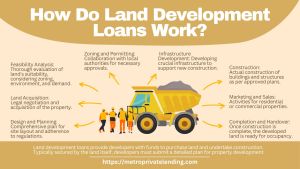
The process of preparing and improving raw land for various uses, such as residential, commercial, or industrial purposes. The development process is multifaceted and typically includes the following stages:
- Feasibility Analysis:
- Developers conduct a thorough analysis of the land’s feasibility for the intended purpose. This involves considering factors such as zoning regulations, environmental impact, infrastructure availability, and market demand.
- Acquisition of Land:
- Once a feasible piece of land is identified, developers negotiate and acquire the property. The acquisition involves legal processes, title checks, and financial transactions.
- Design and Planning:
- Design professionals, including architects and engineers, create a comprehensive plan for the development. This plan includes site layout, infrastructure design, building specifications, and adherence to local regulations.
- Zoning and Permitting:
- Developers work with local authorities to secure necessary zoning approvals and permits for the proposed development. This step ensures that the project aligns with local land-use regulations.
- Infrastructure Development:
- Infrastructure, such as roads, utilities, and drainage systems, is developed to support the new construction. This phase requires coordination with local municipalities and utility providers.
- Construction:
- The actual construction of buildings and other structures takes place according to the approved plans. This involves hiring contractors, managing the construction process, and ensuring quality control.
- Marketing and Sales:
- If the development involves residential or commercial properties for sale, developers engage in marketing and sales activities to attract buyers or tenants. This may include advertising, open houses, and real estate agent collaborations.
- Completion and Handover:
- Once construction is complete, and all necessary approvals are obtained, the developed land is ready for occupancy. For residential developments, this may involve handing over properties to homeowners or tenants.
- Post-Development Activities:
- Developers may be responsible for post-development activities, such as ongoing property management, maintenance of common areas, and compliance with any homeowner association rules.
Types of Projects Financed by Land Development Loans
Land development loans play a vital role in the real estate sector, providing financing for developers and companies looking to convert raw land into buildable properties. These loans cover a variety of costs, including land acquisition, basic infrastructure, and site preparation. There are several types of land development loans, each tailored to different phases of the development process and various types of projects. Below, we’ll outline some of the most common types and the projects for which they are used.
1. Residential Developments
These are projects aimed at constructing housing, whether single-family homes, multi-family units, condos, apartments, or planned communities. Land development may include the installation of utilities, roads, and drainage systems, among others.
2. Commercial Developments
For the construction of commercial buildings such as offices, stores, shopping centers, hotels, and restaurants. These projects often require the creation of infrastructure like parking lots, sidewalks, and access to basic services.
3. Industrial Developments
Include the preparation of land for factories, warehouses, and other industrial facilities. This might involve not only land and basic infrastructure improvement but also managing environmental aspects and zoning specific to industrial uses.
4. Parks and Recreational Spaces
Land development loans can also finance the creation of parks, golf courses, recreational areas, and other leisure spaces. This may include landscape improvement, trail construction, and the installation of supporting infrastructure.
5. Public Infrastructure
Projects dedicated to public infrastructure development, such as roads, bridges, sewage systems, and other critical improvements that benefit the wider community.
6. Mixed-Use Projects
These projects combine residential, commercial, and sometimes industrial elements into an integrated development. Loans for land development for mixed-use projects can finance the wide range of infrastructures needed to support this type of complex development.
7. Urban Renewals and Redevelopment
In urban areas, land development loans can be used for redevelopment projects that transform underused or abandoned lands into valuable, usable properties for new uses, like housing, commerce, or public spaces.
Each of these projects involves different challenges and specific requirements in terms of planning, zoning, environmental impact, and infrastructure needs. Developers seeking a land development loan must prepare and present detailed plans, accurate budgets, and feasibility analyses to secure financing.
Understanding Capital Stack
Capital stack refers to the mix of different sources of financing used to fund a real estate investment. In simple terms, it is how the total capital required for a real estate project is divided between different types of investors or lenders, each with different levels of risk and return.
The most common layers of the capital stack are:
1. Senior Debt: It is the safest and lowest-risk form of financing, typically provided by banks or financial institutions. It offers a fixed return and has priority of payment in case the project experiences difficulties.
2. Mezzanine Debt: It falls between senior debt and preferred equity in terms of risk and return. It offers a higher return than senior debt but also carries a higher risk.
3. Preferred Equity: It is a type of equity that has priority over common equity in the payment of dividends and in the event of liquidation. It offers a fixed return and does not have voting rights in the management of the project.
4. Common Equity: It is the riskiest form of financing, but also with the potential for the highest return. Common equity investors are the owners of the project and have voting rights in the management of the project.
The ideal capital structure for a real estate project will depend on several factors, such as:
- The type of project: Development projects have different financing needs than investment projects in existing properties.
- The risk profile of the investor: Investors with a higher risk tolerance may choose to invest in common equity, while investors seeking a more secure return may choose to invest in senior debt.
- Market conditions: Financial market conditions can affect the availability and cost of different sources of financing.

How to get a Land Development Loan
To qualify for a land development loan, you’ll need to meet certain requirements, including:
- Credit Score: most lenders require a credit score of at least 680 for land development loans.
- Down Payment: most lenders require a down payment of at least 20% for land development loans.
- Pro Forma: you’ll need to provide a detailed pro forma that outlines the costs and expected returns of the development project.
- Experience: most lenders require that you have experience in real estate development.
Getting a land development loan requires preparation and involves convincing lenders of your project’s potential. Here’s a roadmap to securing the financing you need:
1. Prepare a Compelling Project Plan:
- Feasibility Study: Conduct a thorough feasibility study to assess the viability of your project. This includes analyzing market demand, zoning regulations, construction costs, and projected returns on investment (ROI).
- Detailed Budget: Create a comprehensive budget outlining all expenses involved, like land acquisition, permitting, infrastructure development, utilities, and marketing. Ensure realistic revenue projections based on your target market.
- Exit Strategy: Clearly define your exit strategy, whether selling developed land, building on the land yourself, or entering a joint venture. This shows lenders your long-term vision.
2. Strengthen Your Financial Standing:
- Personal and Business Credit: Maintain good credit scores for yourself and any involved businesses. This demonstrates financial responsibility and increases your chances of securing favorable loan terms.
- Equity Investment: Be prepared to invest your own capital in the project. A significant personal stake reassures lenders of your commitment and reduces their perceived risk.
3. Identify the Right Loan Type:
- Land Development Loans: These loans are specifically designed to finance the upfront costs of developing raw land. They typically have shorter terms (12-24 months) and higher interest rates compared to traditional mortgages.
- Construction Loans: If your project involves building on the developed land after acquisition, you might consider a combination of a land development loan and a construction loan.
4. Package a Loan Proposal:
- Create a professional loan proposal outlining your project details. This should include:
- Executive Summary: A concise overview of your project, highlighting its potential and key benefits.
- Project Description: A detailed explanation of your development plan, including the type of development, target market, and construction timeline.
- Financial Projections: Include realistic financial statements with projected costs, revenue, and ROI.
- Team Expertise: Showcase the experience and qualifications of your development team.
- Exit Strategy: Reiterate your plan for recouping the investment.
- Supporting Documents: Include feasibility studies, market research data, and land appraisals.
5. Find the Right Lender:
- Traditional Banks: Larger banks may offer land development loans, but they often have stricter requirements and prefer projects with lower risk profiles.
- Private Lenders: Private lenders may be more flexible with loan terms and can be a good option for projects with unique features or higher risk factors. However, they typically charge higher interest rates.
- Government Programs: Certain government programs might offer loan options or tax incentives for specific types of land development projects (e.g., affordable housing).
6. Negotiate Favorable Terms:
- Don’t settle for the first offer. Shop around and compare terms from multiple lenders. Negotiate key aspects like interest rates, loan-to-value ratio (LTV), and repayment schedules to secure the best possible deal.
The Land Development Loan Process
The land development loan process typically includes the following steps:
- Pre-Approval: you’ll need to provide information about the project, including the location, scope, and timeline.
- Due Diligence: the lender will conduct due diligence to ensure that the project is feasible and that the borrower is a good risk.
- Underwriting: the lender will underwrite the loan and determine the terms and conditions.
- Closing: once the loan is approved, the closing process begins, and the funds are made available to the borrower.
Risks and Benefits of Land Development Loans
Land development loans come with both risks and benefits.
Risks: land development loans are considered high-risk loans. The value of the land can fluctuate, and the development project may not be completed on time or within budget.
Benefits: land development loans provide developers with the funding they need to purchase land and build on it. By developing the land, the developer can create a valuable asset that generates income.
Alternatives to Land Development Loans
If you’re not able to qualify for a land development loan or you’re looking for an alternative, there are several options to consider like, joint ventures, private equity, and crowdfunding to name a few.
- Joint Ventures:
- Explanation: A joint venture (JV) in real estate involves collaboration between two or more parties to undertake a specific development project. Each party contributes resources, whether it’s capital, expertise, or both, and shares the risks and rewards of the venture. Joint ventures are often formed when one party has the land, and the other has the expertise or financial means to develop it.
- Key Points:
- Shared Responsibility: Parties share the responsibilities and risks of the project.
- Expertise and Capital: Combining the strengths of each party to enhance project success.
- Structured Agreements: Detailed agreements outlining contributions, profit-sharing, and decision-making.
- Private Equity:
- Explanation: Private equity involves raising funds from private investors to finance real estate projects. Unlike loans, investors receive an ownership stake in the project, sharing in the profits and losses. Private equity firms pool capital from various investors to create a fund used for multiple real estate ventures. This approach is suitable for larger-scale developments where significant capital is required.
- Key Points:
- Ownership Stake: Investors become partial owners of the real estate project.
- Professional Management: Private equity firms often have professional managers overseeing investments.
- Longer-Term Investments: Typically, private equity investments have a longer time horizon than traditional loans.
- Crowdfunding:
- Explanation: Crowdfunding involves raising small amounts of capital from a large number of individuals through online platforms. Real estate crowdfunding specifically targets real estate projects. Investors can contribute relatively small amounts, and in return, they receive a share of the profits or ownership in the project. This democratized approach allows a diverse group of investors to participate in real estate development.
- Key Points:
- Accessibility: Allows small investors to participate in real estate projects with lower investment amounts.
- Diverse Portfolio: Investors can spread their investment across multiple projects.
- Online Platforms: Crowdfunding platforms facilitate the connection between developers and investors.
-
Federal Housing Administration (FHA) Loans:
Explanation: Government-backed loans are insured by the FHA, making them easier to qualify for. Requires a down payment of as little as 3.5% and has higher interest rates than conventional loans.
Key Points:
- Easier qualification: Lower credit score and down payment requirements.
- Government backing: Reduces risk for lenders.
- Higher interest rates: This can add to the overall cost of the loan.
-
Veterans Affairs (VA) Loans:
Explanation: Government-backed loans are available to eligible veterans and service members. Requires no down payment and has competitive interest rates.
Key Points:
- Exclusive benefit for veterans: Provides access to affordable financing.
- No down payment: Eliminates upfront financial burden.
- Eligibility requirements: Restricted to specific veteran groups.
-
USDA Loans:
Explanation: Government-backed loans are available to borrowers in rural areas. Requires no down payment and has competitive interest rates.
Key Points:
- Supports rural development: Encourages investment in underserved areas.
- No down payment: Reduces upfront costs.
- Location restrictions: Only available in designated rural areas.
-
Hard Money Loans:
Explanation: Short-term, high-interest loans for fix-and-flip properties or situations where conventional financing isn’t available.
Key Points:
- Fast funding: Quick access to capital for time-sensitive projects.
- Flexible requirements: Less stringent credit score and income checks.
- High-interest rates: Can significantly increase borrowing costs.
These alternatives provide flexibility and diverse funding sources for real estate developers who may face challenges securing traditional land development loans. Each option comes with its own set of advantages and considerations, and the choice depends on factors such as project scale, funding requirements, and the desired level of investor involvement.
Land Development Loan FAQs
1. What is the average interest rate on a land development loan?
- Response: The average interest rate on a land development loan can vary and is influenced by factors such as the borrower’s creditworthiness, the lender’s terms, and the perceived risk of the development project. Rates typically range from 4% to 10%, but it’s crucial to consult with lenders directly to get accurate and up-to-date information.
2. How long does it take to get approved for a land development loan?
- Response: The approval timeline for a land development loan varies among lenders and can be influenced by factors such as the complexity of the project, the completeness of the application, and the efficiency of the lender’s approval process. On average, it may take anywhere from a few weeks to a couple of months to receive approval.
3. Can I use a land development loan to purchase a property with an existing structure?
- Response: Land development loans are typically designed for undeveloped land or properties in need of significant improvements. If a property already has structures, a different type of loan, such as a commercial real estate loan, might be more suitable. It’s advisable to clarify the intended use of the loan with the lender during the application process.
4. What is the maximum loan-to-value ratio for a land development loan?
- Response: The maximum loan-to-value (LTV) ratio for a land development loan depends on the lender’s policies, the perceived risk of the project, and the specifics of the development plan. LTV ratios often range from 50% to 75%, meaning the loan amount is limited to a percentage of the land’s appraised value.
5. How much down payment do I need for a land development loan?
- Response: Land development loans typically require a substantial down payment, often ranging from 20% to 50% of the total project cost. The exact percentage depends on factors such as the borrower’s creditworthiness, the project’s risk profile, and the lender’s requirements. A higher down payment may enhance the borrower’s eligibility and improve loan terms.
It’s crucial to note that these responses are general, and specific details may vary based on individual lenders and unique project circumstances. Prospective borrowers are encouraged to engage directly with lenders to obtain accurate and personalized information.
Conclusion
In conclusion, land development loans can be a great way to fund your next development project. By understanding the types of loans available, the qualification process, and the risks and benefits involved, you can make an informed decision about whether a land development loan is right for you. Remember to do your research, have a solid plan, and work with a reputable lender to increase your chances of success.
If you’re looking to maximize your time and profits as a real estate investor, consider a hard money loan from Metro Private Lending. With fast approval and funding, you can quickly purchase and renovate a property and resell it for a profit. Contact us today at 602-699-3501 or email Christopher@metro-az.com to learn more, or visit our website to start your application.