

What are Hard Money Loans?
Hard money loans are a special type of loan used for real estate investments. Instead of relying on the borrower’s credit score, these loans are secured by the property itself. This means that if the borrower defaults on the loan, the lender can take possession of the property to recoup their losses. Hard money loans are typically provided by private lenders or investment groups, rather than traditional banks or credit unions.
Key Features of Hard Money Loans:

Getting a hard money loan is different from a regular bank loan. Forget credit checks! Hard money lenders focus on the value of the house, not your finances. That’s because the house itself acts as a guarantee for the loan. If you can’t repay the loan, the lender can take the house to get their money back. If the borrower defaults, the lender can seize and sell the property to recover their funds.
- Shorter Duration: Hard money loans are the opposite of traditional mortgages when it comes to repayment time. They’re short-term loans, typically lasting just a few months to a few years. This makes them ideal for projects like flipping houses where you fix up a property to sell quickly.
- Higher Interest Rates: Hard money loans get you funding fast, but they come with a steeper price tag. Unlike traditional loans with lower interest rates, hard money loans typically charge more due to the higher risk involved. Remember, they care more about the property than your credit score.
- Faster Funding: Hard money loans can be processed much quicker than traditional loans. This speed can be crucial for real estate investors who need to close deals rapidly or compete in markets where cash offers are prevalent.
- Less Stringent Requirements: These loans often have less stringent underwriting processes. This is beneficial for borrowers who might not qualify for traditional financing due to issues like a low credit score or irregular income.
Common Uses:
- Real Estate Flipping: Investors buy properties, improve them, and sell them at a higher price. The quick availability of funds and short loan terms make hard money loans ideal for this market.
- Land Loans: Since land might not qualify for conventional financing, especially without immediate development plans, hard money can be a viable alternative.
- Construction Loans: Builders often use hard money to start a project before obtaining long-term financing.
- Real Estate Development: Similar to construction loans, developers use hard money to buy and develop a property to its “highest and best use”.
Risks and Considerations:
- Cost: Borrowers must consider the costs, including higher interest rates and possible points (upfront percentage fees based on the loan amount).
- Short Maturity: The need to refinance or pay off a hard money loan quickly can be risky if the exit strategy fails (e.g., a home does not sell as planned).
- Predatory Lending Practices: It’s important to research and verify the credibility of the lender, as the hard money lending space can sometimes attract less scrupulous lenders.
Who uses Hard Money Loans?
Here’s a breakdown of the typical users of hard money loans:
Types of Users:
Real Estate Investors:
- House Flippers: Investors who buy distressed properties, renovate them, and sell them quickly for a profit.
- Buy-and-Hold Investors: Investors who purchase rental properties to generate passive income and build long-term wealth.
Real Estate Developers:
- Developers who acquire land or properties with the intent to develop them into residential or commercial projects.
- Builders who need short-term financing to start a construction project before obtaining permanent financing.
Small Business Owners:
- Entrepreneurs who need capital for business expansion, inventory purchases, or to bridge cash flow gaps. In some cases, they may use real estate as collateral for the loan.
Individual Homebuyers:
- Homebuyers who cannot secure traditional financing due to credit issues, but have a substantial down payment and a clear exit strategy. They might use a hard money loan as a temporary solution until they can refinance with a conventional mortgage.
Situations Where Hard Money Loans Are Used:
- Quick Purchases: When an opportunity arises to purchase a property below market value, hard money loans can provide the fast funding needed to secure the deal.
- Renovations: Investors often use hard money to finance renovations or improvements that will increase the property’s value.
- Bridge Loans: Borrowers might use hard money loans as a short-term solution to “bridge” the gap between buying a new property and selling an existing one.
- Credit Issues: Borrowers with credit challenges might turn to hard money lenders when traditional lenders deny their loan applications.
Considerations for Users:
- Costs: Users must be aware of the higher interest rates, fees, and potentially shorter loan terms associated with hard money loans.
- Exit Strategy: Having a clear plan to repay the loan is crucial, as hard money loans often require a balloon payment at the end of the term.
- Due Diligence: It’s essential to research and vet potential hard money lenders to ensure they are reputable and offer fair terms.
How Hard Money Loans Work
Think of hard money loans as an alternative financing option for real estate ventures. Unlike traditional loans that require a good credit score and stable income, hard money loans focus on the property itself. This can be a lifeline for borrowers with less-than-perfect credit. But there’s a catch! These loans come with their own set of rules. We’ll explore the inner workings of hard money loans, including how they rely on the property as security (collateral-based lending), the loan amount compared to the property value (loan-to-value ratio), interest rates, additional charges (like points and origination fees), and other key details.
-
Collateral-Based Lending
Primary Criterion: The main criterion for a hard money loan is the value of the property being used as collateral, not the borrower’s credit score or income. Hard money lenders need to ensure that the property value is sufficient to cover the loan amount in case of a default.
Risk Management: Since the lender’s risk is mitigated through property value, they are typically more willing to overlook issues like poor credit scores or previous foreclosures that would be disqualifying factors for traditional lenders.
-
Loan-to-Value Ratios (LTV)
Definition: The LTV ratio is a measure of the loan amount divided by the value of the property. For example, if a property is valued at $100,000 and the loan amount is $75,000, the LTV ratio is 75%.
Typical LTV: Hard money lenders usually offer lower LTV ratios compared to traditional banks — often 50% to 70%, although it can go higher depending on the perceived risk and the lender’s policies. This lower ratio protects the lender by ensuring they have a buffer in case the property needs to be sold quickly.
After Repair Value (ARV): Some hard money lenders consider the ARV, which is the estimated value of the property after renovations are completed. This can allow for a higher loan amount if the improvements significantly increase the property value.
-
Interest Rates, Points, and Fees
Interest Rates: Hard money loans typically have higher interest rates than conventional loans due to the higher risk and shorter term of the loan. Rates can vary widely depending on the market, the lender, the property, and the borrower’s situation, but they generally range from 8% to 15% or more.
Points: Points are upfront fees paid to the lender, calculated as a percentage of the loan amount. For example, two points on a $100,000 loan equals $2,000. Points on hard money loans can range from 2% to 10%, significantly higher than those in conventional loans, compensating the lender for the risk and the short duration of the loan.
Other Fees: There can be a range of other fees involved with hard money loans, including loan origination fees, closing costs, and appraisal fees. Borrowers should carefully review all fees as these can add up and impact the total cost of borrowing.
How the Process Works
- Application and Approval: The borrower applies with a hard money lender, providing details about the property and the investment plan. The lender evaluates the property’s value and the proposed project.
- Funding: If approved, the loan can be funded very quickly, sometimes within a week, which is much faster than traditional bank loans.
- Repayment: The borrower makes regular interest payments during the term of the loan, which typically lasts from 6 months to a few years. At the end of the term, the borrower must pay back the full principal amount, often through either the sale of the property or refinancing with a more traditional lender.
When to Consider a Hard Money Loan
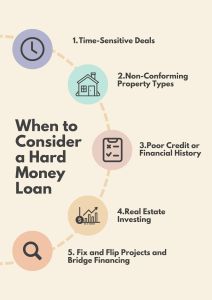
Hard money loans can be an appealing option under several circumstances, especially in the realm of real estate and business financing where traditional funding routes may not be feasible or quick enough. Here’s when considering a hard money loan is particularly advisable:
- Time-Sensitive Deals
Quick Closings: In real estate markets where properties sell quickly, securing financing faster than traditional banks can offer is crucial. Hard money lenders can often fund deals within a week or two, unlike banks which might take 30 days or more.
Auction Purchases: Properties bought at auctions usually require quick payment. Hard money loans can provide the necessary funds on a short timeline.
- Non-Conforming Property Types
Unique Properties: If a property does not conform to standard lending criteria (e.g., a unique commercial building or a multi-use property), traditional lenders may be hesitant to finance the purchase. Hard money lenders are more flexible and often willing to consider non-traditional or unique property types.
Properties Needing Repairs: Traditional lenders might not finance properties that require significant renovation. Hard money lenders, however, often look at the potential value of the property after repairs (the ARV – After Repair Value), making them a suitable option for financing distressed properties.
- Poor Credit or Financial History
Credit Issues: Borrowers with low credit scores, foreclosures, or bankruptcy in their financial history might find it challenging to secure loans from traditional banks. Hard money lenders primarily focus on the asset value rather than the borrower’s credit, making this a viable alternative.
Documentation Challenges: Self-employed individuals or those without steady income streams might struggle with the documentation requirements of traditional loans. Hard money loans require less financial documentation, focusing more on collateral.
- Real Estate Investors
Portfolio Expansion: Investors looking to rapidly expand their portfolios without being limited by loan caps or slow banking processes can benefit from hard money loans.
Leveraging Opportunities: Investors may use hard money loans to leverage more properties than they could typically afford by using the loan to cover a significant portion of the purchase price.
- Fix-and-Flip Projects
Short-term Projects: Flippers who buy properties to renovate and sell for a profit within a short timeframe find hard money loans ideal due to their short loan terms and quick funding.
Funding for Renovations: Hard money can cover not only the purchase price of the property but also the cost of renovations, which is a significant advantage for flippers.
- Bridge Financing
Between Transactions: A hard money loan can serve as bridge financing for a business or individual needing to cover immediate expenses while waiting for more permanent financial arrangements.
Property Transition: Owners of commercial properties that are transitioning (e.g., from being vacant to fully leased) might use hard money loans to stabilize the property before refinancing with a traditional mortgage at a lower interest rate.
Types of Hard Money Lenders
Hard money lenders come in various forms, each with its unique characteristics, requirements, and lending criteria. Here are the different types of hard money lenders you might encounter:
-
Private Individuals or Groups
Individual Investors: These are private individuals who have surplus funds and are looking for investment opportunities. They might be retirees, professionals, or entrepreneurs interested in real estate as a way to generate returns.
Private Investment Groups: These are groups of private investors who pool their funds to provide hard money loans. They might have specific expertise in particular property types or markets, allowing them to evaluate potential investments more effectively.
Family Offices: Wealth management firms that manage investments for high-net-worth families often engage in private lending activities, including hard money loans.
Pros:
- Flexible Terms: Private lenders often offer more flexible terms compared to institutional lenders.
- Personalized Service: Borrowers can often negotiate directly with the decision-makers, leading to quicker approvals and more personalized service.
Cons:
- Higher Interest Rates: Private individuals and groups may charge higher interest rates compared to other types of hard money lenders.
- Limited Scalability: The amount of available capital might be limited, restricting the size of loans they can offer.
-
Investment Companies
Specialized Firms: These are companies that specialize in providing hard money loans for real estate investments. They might focus on specific property types, regions, or investment strategies.
Real Estate Funds: Some investment companies manage funds specifically allocated for hard money lending, leveraging the pooled resources of multiple investors.
Pros:
- Professional Expertise: Investment companies often have experienced professionals who specialize in evaluating real estate investment opportunities.
- Scalability: These companies can typically handle larger loan amounts compared to individual lenders or groups.
Cons:
- Less Flexibility: While more professional, investment companies might have stricter lending criteria compared to individual investors.
- Higher Overhead Costs: This could translate to higher fees and interest rates for borrowers.
-
Peer-to-Peer (P2P) Lenders
Online Platforms: P2P lending platforms connect borrowers directly with individual investors willing to fund their loans. These platforms facilitate the loan application, approval, and repayment processes online.
Crowdfunding Platforms: Some P2P platforms operate on a crowdfunding model where multiple investors contribute smaller amounts to fund a single loan.
Pros:
- Accessibility: P2P platforms often provide easier access to hard money loans, especially for borrowers who might not qualify for traditional bank loans.
- Competitive Rates: Due to the competitive nature of these platforms, borrowers might find relatively lower interest rates compared to other hard money lenders.
Cons:
- Platform Fees: P2P platforms usually charge fees for their services, which can add to the overall cost of borrowing.
- Limited Personal Interaction: Borrowers might have limited direct interaction with individual lenders, which could affect the level of personalized service.
There’s no one-size-fits-all when it comes to hard money lenders. Each type has its own pros and cons, and the best choice depends on your specific needs, investment type, and loan terms.
Whether you’re a real estate investor needing fast cash or someone with an offbeat project, understanding the different hard money lenders will help you score the perfect fit.
Risks and Drawbacks of Hard Money Loans
Hard money loans can be a useful tool for real estate investors and other borrowers who need quick access to funds, especially when traditional financing isn’t an option. However, these loans come with certain risks and drawbacks that need careful consideration:
-
High Interest Rates and Fees
Higher Costs: Hard money loans typically have higher interest rates compared to traditional bank loans. This is due to the increased risk that the lenders take on by focusing on the collateral value rather than the borrower’s creditworthiness. Interest rates can vary widely but often range from 8% to 15% or even higher.
Additional Fees: Beyond interest rates, hard money loans can also carry numerous fees such as origination fees, closing costs, and points (upfront percentage fees based on the loan amount). These fees increase the total cost of borrowing.
-
Short Repayment Periods
Loan Term: Unlike traditional mortgages which might have terms of 15 to 30 years, hard money loans usually have much shorter durations, ranging from a few months to a few years. This short repayment period can be a significant burden, requiring the borrower to secure refinancing or sell the property quickly to pay off the loan.
Pressure to Refinance or Sell: The need to refinance or sell rapidly can be problematic, especially if the property market is slow or if the borrower encounters unexpected complications in renovating and selling a property.
-
Risk of Asset Seizure
Collateral Foreclosure: Since hard money loans are secured by property collateral, failing to repay the loan can result in the lender seizing the asset. This risk is particularly acute because of the shorter terms and higher costs associated with these loans.
Dependence on Property Value: If the property’s value decreases below the loan amount due to market fluctuations or other factors, borrowers might find themselves in a negative equity situation, increasing the risk of losing the property.
-
Potential for Scams
Predatory Lending Practices: The less regulated nature of hard money lending can sometimes attract unscrupulous lenders who engage in predatory lending practices. This can include unreasonable terms, hidden fees, or bait-and-switch schemes.
Due Diligence: It’s vital for borrowers to perform thorough due diligence on potential lenders to ensure they are reputable and to fully understand the terms of the loan. Consulting with legal and financial professionals before signing any agreements is highly advisable.
Considerations
- Risk Management: To mitigate these risks, borrowers should plan carefully, considering how they will repay the loan through refinancing or selling the property. Having a clear exit strategy is essential.
- Cost Analysis: It’s important to analyze all costs involved thoroughly and determine if the project’s potential return is worth the high costs of financing. Sometimes, the expense of a hard money loan might not justify the investment.
- Regulatory Compliance: Ensuring that the lender complies with all relevant state and federal regulations can help protect against fraud and unfair lending practices.
While hard money loans provide an important financing option in specific situations, they carry inherent risks and costs that can impact the financial stability of a borrower. They are best used as short-term solutions with a clear and achievable plan for exit. Understanding the full scope of potential pitfalls is crucial to making informed decisions about using hard money loans effectively and safely.
How to Choose the Right Hard Money Lender

Choosing the right hard money lender is a crucial step in ensuring a successful and profitable real estate investment or business venture. Given the high stakes and costs associated with hard money loans, thorough research and due diligence are essential. Here are some key factors to consider when selecting a hard money lender:
-
Research and Due Diligence
Market Research: Understand the current market rates, loan terms, and typical lending criteria for hard money loans in your area or for your specific type of project.
Compare Multiple Lenders: Don’t settle for the first lender you come across. Compare terms, interest rates, fees, and other conditions from multiple lenders to find the best fit for your needs.
Check Licensing and Regulation: Ensure that the lender is licensed to operate in your state and complies with all relevant regulations. This information can usually be verified through state regulatory agencies.
-
Reputation and Experience
Read Reviews and Testimonials: Look for reviews and testimonials from other borrowers to gauge the lender’s reputation. Websites, forums, and industry publications can be valuable resources.
Ask for References: Reputable lenders should be willing to provide references or put you in touch with past clients who can vouch for their services.
Experience in Your Market: Choose a lender who has experience financing projects similar to yours, whether it’s residential properties, commercial real estate, fix-and-flip projects, or business loans. They will be more familiar with the specific challenges and opportunities of your market.
-
Loan Terms and Conditions
Interest Rates: Understand the interest rates offered by different lenders and how they compare to market rates. Be wary of rates that are significantly higher than average.
Fees and Charges: Carefully review all fees, including origination fees, closing costs, and points. These can significantly impact the total cost of borrowing.
Loan-to-Value (LTV) Ratio: Consider the lender’s maximum LTV ratio and how it aligns with your financing needs. A lower LTV might mean a smaller loan but can also reduce risk.
Loan Term and Repayment Options: Evaluate the loan term and repayment options to ensure they align with your project timeline and exit strategy. Some lenders offer more flexibility than others in terms of repayment schedules and penalties for early repayment.
Additional Considerations
- Communication and Transparency: Choose a lender who communicates clearly and transparently about their loan terms, requirements, and processes. Avoid lenders who use high-pressure sales tactics or are evasive about answering your questions.
- Accessibility: Consider how accessible the lender’s team is and whether they are responsive to your inquiries and concerns. Good communication is vital, especially during the loan application and approval process.
- Legal Review: Consult with legal professionals to review any loan agreements before signing to ensure you fully understand the terms and to identify any potential red flags or hidden clauses.
Choosing the right hard money lender requires careful consideration and due diligence to ensure that you’re entering into a fair and mutually beneficial agreement. By researching multiple lenders, checking their reputation and experience, and thoroughly reviewing loan terms and conditions, you can make an informed decision that aligns with your financial goals and project requirements. Investing time upfront to select the right lender can save you significant costs and headaches down the line.
Application and Approval Process
Navigating the application and approval process for a hard money loan can seem daunting, but understanding the steps involved can help streamline the process and increase your chances of success. Here’s a breakdown of the typical stages and what to expect:
-
Application and Approval Process
Initial Inquiry: Begin by reaching out to potential lenders to discuss your project and financing needs. Many lenders offer online applications or initial consultation calls to gather basic information and assess your eligibility.
Pre-Approval: After evaluating your project and financial situation, the lender may provide a pre-approval letter outlining the terms they are willing to offer. This is not a guarantee of funding but a preliminary indication of interest.
Formal Application: Once you decide to proceed, you’ll need to submit a formal loan application, along with the required documentation (discussed below). The lender will review your application in detail to assess the risk and determine whether to proceed with underwriting.
-
Required Documentation
Property Information: Detailed information about the property you intend to purchase, including its address, purchase price, and current condition.
Exit Strategy: A clear plan outlining how you intend to repay the loan, such as through the sale of the property, refinancing, or other means.
Financial Statements: Depending on the lender, you may need to provide personal or business financial statements, including bank statements, tax returns, and proof of income.
Credit Report: While hard money lenders focus less on credit scores, some may still require a credit report to assess your overall financial situation.
Project Budget and Timeline: A detailed budget for the project, including renovation costs, holding costs, and contingency reserves, along with a timeline for completion.
-
Underwriting and Loan Approval
Property Evaluation: The lender will conduct a thorough evaluation of the property’s value, often through an independent appraisal or inspection. They will consider factors like location, condition, and potential after-repair value (ARV).
Risk Assessment: The lender will assess the overall risk of the loan based on the property, your financial situation, and the viability of your exit strategy. This process involves a combination of automated algorithms and manual review.
Loan Terms: Once underwriting is complete, the lender will finalize the loan terms, including interest rates, loan amount, fees, and repayment schedule. You’ll receive a Loan Estimate detailing these terms for your review.
-
Funding and Disbursement
Loan Agreement: After approval, you’ll sign a loan agreement outlining the terms and conditions. Review this document carefully and consult with legal counsel if needed to ensure you understand all obligations.
Closing: The final step is the loan closing, where you’ll sign all necessary paperwork, and the lender will disburse the funds. This can often be done electronically or at a title company’s office.
Funding: Once all documents are signed and any required upfront fees or points are paid, the lender will fund the loan. Funds are typically disbursed directly to the borrower or a designated escrow account, depending on the project’s requirements.
The application and approval process for a hard money loan can vary depending on the lender and the specifics of your project. While the process might seem complex, breaking it down into these stages can help you navigate it more effectively. Be prepared with all required documentation, maintain clear communication with your lender, and seek professional advice when needed to ensure a smooth and successful funding experience. Working closely with a reputable lender who communicates openly and transparently can make all the difference in securing the financing you need for your real estate investment or business venture.
Managing and Repaying a Hard Money Loan
Managing and repaying a hard money loan effectively requires careful planning, clear communication with the lender, and an understanding of your repayment options. Here are key aspects to consider to ensure smooth management and successful repayment of a hard money loan:
Payment Schedule and Options
- Understanding the Terms: Familiarize yourself with the specific payment terms of your loan. Hard money loans often have interest-only payments followed by a balloon payment at the end of the loan term, which includes the principal and any remaining interest.
- Payment Options: Determine what payment methods are accepted by your lender (e.g., automatic bank withdrawals, checks, online payments) and the due dates for each installment. Setting up automated payments can help avoid missed payments and potential penalties.
- Flexibility and Penalties: Know the flexibility your lender offers for missed payments or late fees. Understanding the consequences of a late or missed payment is crucial for managing your finances effectively.
Loan Servicing and Communication
- Regular Communication: Maintain regular contact with your lender. Informing them of any potential financial difficulties, changes in your project’s timeline, or other challenges ahead of time can help in finding mutually agreeable solutions.
- Loan Servicing: Some hard money lenders handle loan servicing in-house, while others may outsource this function. Knowing who to contact for any issues related to your loan is important for effective communication and problem resolution.
- Monitoring and Reporting: Keep detailed records of all communications, payments, and statements related to your loan. Regular monitoring of your loan balance and any accrued interest is necessary to stay informed about your financial status.
Refinancing or Paying Off the Loan
- Refinancing Options: If you cannot pay off the balloon payment at the end of the loan term, refinancing the loan with another lender or transitioning to a more traditional loan product might be necessary. Begin exploring refinancing options well in advance of the balloon payment due date.
- Early Repayment: Some hard money loans may come with prepayment penalties, so it’s important to understand if your loan has any penalties for early repayment. Paying off the loan early can save on interest, but only if it doesn’t trigger additional fees.
- Exit Strategy Execution: Your exit strategy should be planned and initiated early in the project. Whether it’s selling the property or obtaining long-term financing, timely execution of your exit strategy is crucial to avoid costly extensions of your hard money loan.
Additional Tips for Management
- Budget Management: Keep your project on budget to ensure that funds are available for loan repayment. Unexpected expenses can jeopardize your ability to meet the loan obligations.
- Contingency Planning: Have contingency plans in case your primary exit strategy fails. This could include additional financing options or alternative selling strategies for the property.
- Professional Advice: Consult with financial advisors, particularly when considering refinancing options or managing more complex real estate transactions.
Managing a hard money loan requires attention to detail, proactive financial management, and continuous communication with your lender. By understanding the terms, maintaining good communication, and executing a solid exit strategy, you can manage the loan effectively and minimize financial risks.
Case Studies and Examples of Successful Hard Money Loans
Let’s explore some hypothetical case studies to illustrate how different individuals and businesses have successfully used hard money loans.
Case Study 1: Real Estate Investor – Fix-and-Flip Project
Background: Sarah is a real estate investor looking to purchase a distressed property to renovate and sell for a profit.
Loan Details:
- Loan Amount: $200,000
- Interest Rate: 12%
- Loan Term: 12 months
Success Story:
Sarah identified a property in a desirable neighborhood priced below market value due to its poor condition.
She secured a hard money loan to purchase the property and fund the renovations.
After completing the renovations within 6 months, Sarah sold the property for $350,000, generating a net profit of $100,000 after repaying the loan and associated costs.
Pros:
- Quick access to funds enabled Sarah to capitalize on a lucrative investment opportunity.
- Flexibility of terms allowed her to repay the loan early after the successful sale.
Cons:
- High-interest rates and fees increased the overall cost of the project.
- The short loan term added pressure to complete renovations and sell the property quickly.
Case Study 2: Small Business Owner – Restaurant Expansion
Background: Mike owns a successful restaurant and wants to expand by opening a new location.
Loan Details:
- Loan Amount: $150,000
- Interest Rate: 10%
- Loan Term: 18 months
Success Story:
Mike secured a hard money loan to cover the initial costs of leasing a new location, renovating the space, and purchasing equipment.
The new restaurant opened within the 18-month loan term and quickly became profitable.
Mike was able to refinance the hard money loan with a traditional bank loan at a lower interest rate once the new location demonstrated strong revenue.
Pros:
- The quick approval and funding process allowed Mike to seize the opportunity for expansion without delay.
- The success of the new location enabled Mike to refinance the loan on favorable terms.
Cons:
- The high initial interest rate increased the startup costs and affected cash flow during the loan term.
- Short loan term required Mike to secure refinancing promptly to avoid default.
Summary
Real Estate Investor (Sarah)
- Pros: Quick funding, flexibility in repayment after the project’s success.
- Cons: High costs, short repayment period leading to pressure for quick turnaround.
Small Business Owner (Mike)
- Pros: Opportunity for quick expansion, ability to refinance at lower rates after demonstrating success.
- Cons: High initial interest rate impacting cash flow, need for timely refinancing.
Summary of Key Takeaways about Hard Money Loans
- Versatility: Hard money loans offer flexible financing solutions for real estate investors, small business owners, and other borrowers who need quick access to capital.
- Speed: Compared to traditional loans, hard money loans have a faster approval and funding process, making them ideal for time-sensitive opportunities.
- Higher Costs: The convenience and flexibility of hard money loans come at a higher cost, with higher interest rates, fees, and shorter loan terms.
- Collateral-Based Lending: Hard money loans are secured by collateral, typically the property being financed, reducing the emphasis on credit scores and financial history.
- Exit Strategy: A clear and viable exit strategy is crucial for managing and repaying hard money loans, especially given the short-term nature of these loans.
- Due Diligence: Thorough research, due diligence, and communication with potential lenders are essential for selecting a reputable and suitable hard money lender.
Final Thoughts on Hard Money Loans
Despite the drawbacks, hard money loans can be a game-changer if used strategically. By doing your homework – understanding the terms, costs, and repayment plan – and choosing a reputable lender with open communication, you can leverage the benefits of hard money loans to achieve your financial goals.
Why Choose Metro Private Lending?
By leveraging our fast approval and funding processes, you can swiftly acquire and renovate properties, allowing for a quicker turnaround and the potential for higher returns.
Ready to Take Action?
Contact us today at 602-699-3501 or email Christopher@metro-az.com to learn more. You can also visit our website to begin your online application and unlock the potential of rehab loans for your real estate investments.
FAQs
- What is the difference between a Hard Money Loan and a Traditional Loan?
Hard Money Loan:
Secured by Collateral: Typically secured by the property being financed.
Higher Interest Rates: Generally have higher interest rates compared to traditional loans.
Shorter Loan Terms: Often have shorter repayment periods, ranging from a few months to a few years.
Flexible Approval: Focuses more on the value of the collateral and the viability of the project rather than the borrower’s credit history.
Traditional Loan:
Lower Interest Rates: Generally offer lower interest rates than hard money loans.
Longer Loan Terms: Often have longer repayment periods, typically ranging from 15 to 30 years for mortgages.
Strict Approval Criteria: Requires a strong credit history, proof of income, and other financial documentation.
Purpose: Can be used for a variety of purposes, including real estate, business, personal expenses, etc.
- How long does it take to get approved for a Hard Money Loan?
Hard money loans are known for their speedy approvals. Unlike traditional loans that can take weeks or months, hard money loans can get approved in just a few days to a couple of weeks, depending on the lender and your project’s details.
- Can Hard Money Loans be used for non-real-estate purposes?
While hard money loans are primarily associated with real estate financing, some lenders may offer hard money loans for business purposes or other investment opportunities. However, the availability and terms for non-real-estate hard money loans can vary significantly.
- What happens if I can’t repay a Hard Money Loan?
If you can’t repay a hard money loan, the lender may foreclose on the property used as collateral to recover their investment. It’s crucial to have a viable exit strategy and contingency plans to avoid defaulting on the loan.
- Are Hard Money Loans regulated?
Hard money loans aren’t as strictly controlled as traditional loans. However, there are still state and federal regulations they need to follow, like licensing and borrower protection laws. Always choose a reputable lender who plays by the rules.
- Are Hard Money Loans a good option for first-time borrowers?
Hard money loans can be tricky for first-timers. The high costs, short repayment terms, and strict property requirements can be a tough hurdle. But, if you have a rock-solid investment plan, understand the risks, and can manage the loan like a pro, they might still be an option.